
Free Tool · Excavation Calculator
Free Excavation Calculator: Cubic Yards and Dump Truck Loads

Andrew Drish, founder
Published . Updated
An excavation calculator turns the length, width and depth of a dig into cubic yards, adds swell, and tells you how many dump truck loads it takes. This one is for excavation and dirtwork contractors pricing a dig or lining up trucks. It's free, there's no sign-up, and it runs in your browser. Nothing you type is sent anywhere.
Excavation Calculator: Your Dig in Cubic Yards and Loads
Example values. Change them to your job.
Swell and weight from Caterpillar and FHWA tables, read November 17, 2026. The two disagree; see the table below.
- Bank cubic yards (in the ground)
- 177.8
- Loose cubic yards (in the truck)
- 218.7
- Loads by volume
- 19
- Tons
- 231.1
- Loads by weight
- 16
Plan on 19 loads.
The truck is full before it hits its payload, so volume sets the count.
How it works: bank cubic yards = length × width × depth ÷ 27. Loose cubic yards = bank × (1 + swell). Loads = loose cubic yards ÷ truck capacity, rounded up. Tons = bank cubic yards × weight ÷ 2,000.
How to Calculate Excavation Volume in Cubic Yards
Multiply length × width × depth in feet. That's cubic feet. Divide by 27, because a cubic yard is 3 feet × 3 feet × 3 feet. That's your bank cubic yards: the dirt as it sits in the ground. Then add swell, because dirt takes up more room once it's dug.
Here's the example the calculator starts with. It's an example, not a typical job. A dig 40 feet long, 30 feet wide and 4 feet deep, in earth, loam from the Caterpillar table (23% swell), hauled in a 12 cubic yard truck:
- 40 × 30 × 4 = 4,800 cubic feet.
- 4,800 ÷ 27 = 177.8 bank cubic yards.
- 177.8 × 1.23 = 218.7 loose cubic yards.
- 218.7 ÷ 12 = 18.22, rounded up to 19 loads.
Always round loads up. Nobody leaves the last bit of the hole in the ground because it didn't fill a whole truck.
Swell Factors by Soil Type
Bank cubic yards are the dirt in the ground, the hole you dig. Loose cubic yards are the same dirt after it's broken up, and that's what fills the truck. Swell is the difference. We read two published tables, Caterpillar's and the FHWA's, and they give different numbers for the same soil, sometimes very different. So the table shows both, and the range between them. We didn't average them. The calculator lets you pick either one, or type your own.
| Material | Caterpillar | FHWA Federal Lands | Range |
|---|---|---|---|
| Clay | 22% (natural bed) | 50% dry, 67% damp | 22% to 67% |
| Earth and loam | 25% (dry packed), 23% (loam) | 50% dry, 43% damp, 0% wet mud | 0% to 50% |
| Gravel | 12% (pit run) | 20% dry, 10% wet | 10% to 20% |
| Sand | 12% (dry, loose) | 11% dry | 11% to 12% |
| Sand and gravel, dry | 12% | Not in its table | 12% (one source) |
| Topsoil | 43% | 56% | 43% to 56% |
| Crushed stone | 67% | Not in its table | 67% (one source) |
| Shale | Not in its table | 79% | 79% (one source) |
| Limestone | Not in its table | 63% | 63% (one source) |
| Decomposed rock, half rock and half earth | Not in its table | 38% | 38% (one source) |
Read November 17, 2026. Caterpillar prints a load factor (loose weight ÷ bank weight), not a swell percent, so its swell here is 1 ÷ load factor − 1, rounded: clay at a 0.82 load factor is 22%. Cat notes that weight varies with moisture, grain size and compaction, and that tests give the exact figures. FHWA (Exhibit 5.1 A) prints the loose swell itself and says its factors are "subject to ±33% variation." We left out FHWA's wet sand row because we couldn't make its pound and kilogram columns agree.
The Short Version
- Bank cubic yards (in the ground) = length × width × depth, in feet, ÷ 27.
- Loose cubic yards (in the truck) = bank cubic yards × (1 + swell). In the two published tables we used, swell runs from 0% to 79%, depending on the soil and the source.
- Loads by volume = loose cubic yards ÷ truck capacity, rounded up. A partial load is still a trip.
- Loads by weight = tons ÷ the truck's payload, rounded up. Plan on whichever number is bigger.
- It's a quick check, not a takeoff. Plans, cut and fill, and compaction belong in takeoff software.
On This Page
Dump Truck Load Calculator: How Many Loads Is It?
A dump truck is done for a trip one of two ways. It runs out of room, or it hits its payload. The calculator checks both. By volume: loose cubic yards ÷ the truck's capacity in cubic yards, rounded up. By weight: bank cubic yards × the material's weight per bank cubic yard ÷ 2,000 gives tons; tons ÷ the truck's payload in tons, rounded up, gives loads. Plan on whichever number is bigger, because the truck can't carry past either limit.
An example where weight wins (example values, not a typical truck). The same 40 × 30 × 4 foot dig, in gravel, wet from the FHWA table: 10% swell and 3,640 pounds per bank cubic yard. A 12 cubic yard truck with a 15 ton payload. By volume it's 195.6 loose cubic yards, 17 loads. By weight it's 323.6 tons, 22 loads. Plan on 22 loads. Wet, heavy material fills the payload long before it fills the bed.
Use the payload your truck is rated for. Legal weight limits vary by state, so this calculator doesn't use one, and we don't print one here. The weights below are pounds per cubic yard from the same two tables. Use the bank weight with bank yards, which is what the calculator does.
| Material | Table | Bank (lb per cubic yard) | Loose (lb per cubic yard) |
|---|---|---|---|
| Clay, natural bed | Caterpillar | 3,400 | 2,800 |
| Earth, dry packed | Caterpillar | 3,200 | 2,550 |
| Earth, loam | Caterpillar | 2,600 | 2,100 |
| Gravel, pit run | Caterpillar | 3,650 | 3,250 |
| Sand, dry loose | Caterpillar | 2,700 | 2,400 |
| Sand and gravel, dry | Caterpillar | 3,250 | 2,900 |
| Topsoil | Caterpillar | 2,300 | 1,600 |
| Crushed stone | Caterpillar | 4,500 | 2,700 |
| Clay, dry | FHWA | 3,220 | 2,150 |
| Clay, damp | FHWA | 3,350 | 2,010 |
| Earth, loam, dry | FHWA | 3,030 | 2,070 |
| Earth, loam, damp | FHWA | 3,370 | 2,360 |
| Earth, loam, wet (mud) | FHWA | 2,940 | 2,940 |
| Gravel, dry | FHWA | 3,280 | 2,730 |
| Gravel, wet | FHWA | 3,640 | 3,290 |
| Sand, dry | FHWA | 2,880 | 2,590 |
| Topsoil | FHWA | 2,430 | 1,620 |
| Shale | FHWA | 4,450 | 2,480 |
| Limestone | FHWA | 4,380 | 2,690 |
| Decomposed rock, half rock, half earth | FHWA | 3,750 | 2,710 |
Read November 17, 2026, from Caterpillar ("Bank" and "Loose" columns) and FHWA ("In-Situ" and "Loose" columns, Exhibit 5.1 A). FHWA says its in-situ densities are "subject to average ±5% variation." Your own material can weigh more or less.
Once the trucks are running, the count that matters is the one on the tickets. Our dump truck software guide shows how to log each load as it happens.
Trench and Slope Excavation
A trench is just a long, narrow dig, so it's the same formula. Example values: a trench 200 feet long, 3 feet wide and 6 feet deep is 3,600 cubic feet, ÷ 27 = 133.3 bank cubic yards. Put those numbers in the calculator and pick the soil.
For a dig with sloped sides, use the average width: depth × (top width + bottom width) ÷ 2 × length, then ÷ 27. Example values: 100 feet long, 8 feet deep, 4 feet wide at the bottom and 20 feet wide at the top. The average width is (20 + 4) ÷ 2 = 12 feet. 8 × 12 × 100 = 9,600 cubic feet, ÷ 27 = 355.6 bank cubic yards. In the calculator, type 12 as the width.
If all four sides slope, like a pond or a basement hole, averaging the length and the width comes out a little low. For that, and for anything with changing depths, use a takeoff. The calculator also doesn't tell you what slope or shoring the soil needs. That's a safety call made on the job, not by a calculator.
What This Calculator Does Not Tell You
- It's not a takeoff. It doesn't read plans, surfaces or grades, and it doesn't balance cut and fill across a site.
- It doesn't handle compaction for fill. Dirt placed and compacted takes up less room than it did in the ground. FHWA's table lists that shrinkage separately, and this calculator doesn't use it.
- Real swell and weight change with moisture and rock. Both tables say so. If you've hauled this pit's material before, your own numbers beat any table.
- It doesn't know your truck's legal limit. Use the truck's own payload rating, and your state's rules.
- It doesn't price the job. Trucking cost depends on cycle time, distance and your rates.
For the full dirt math, the takeoff tools are AGTEK, InSite and HeavyBid. We cover what they do, and where SmartCrew starts after them, on our earthwork software page.
How Many Loads It Should Take vs How Many It Did
This calculator tells you how many loads the dig should take. It can't tell you how many it did take. Lost hauling tickets were one of the headaches that pushed us to build SmartCrew in the first place.
So SmartCrew has hauling software built in. Every load gets a digital ticket from the crew's phone: the truck, the job, the material and the yards. Snap a photo of a paper ticket and the AI reader enters it. The loads land on the job, so trucking shows up in the job's cost while the job is running. Then you can hold the plan from this page up against what actually got hauled.
SmartCrew is built for dirtwork and heavy civil contractors with 5 to 100 employees. SmartCrew starts at $99/month.
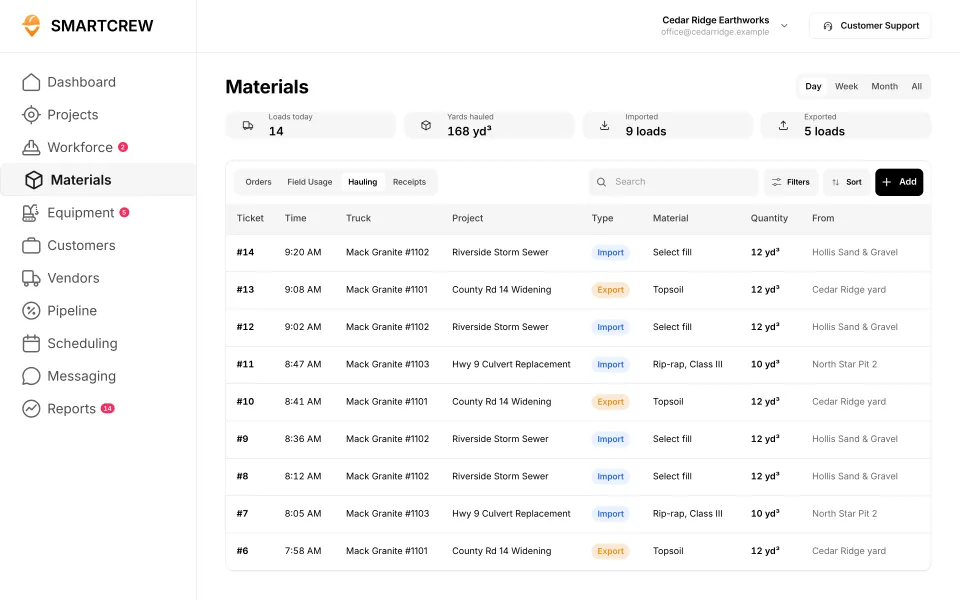
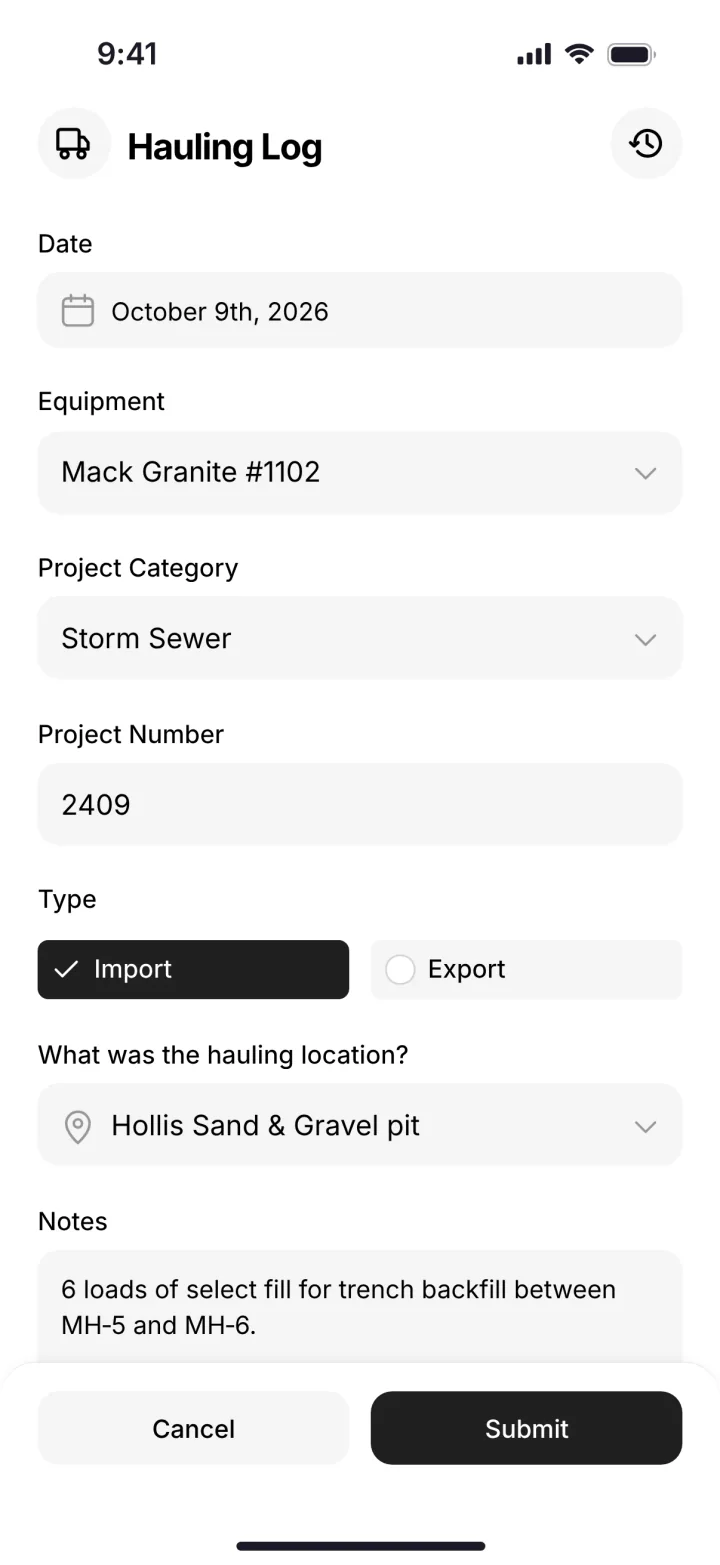
The hauling log on the web and the load ticket on the phone. (Demo account.)
Questions People Ask
What Is Swell in Excavation?
Swell is how much bigger soil gets when it's dug out of the ground. A bank cubic yard of clay turns into more than a cubic yard in the truck. How much depends on the soil and the table you read: Caterpillar's figures work out to 22% for clay in its natural bed, and FHWA lists 50% for dry clay and 67% for damp clay.
How Do I Convert Cubic Feet to Cubic Yards?
Divide by 27. A cubic yard is 3 feet × 3 feet × 3 feet, which is 27 cubic feet. So 1,000 cubic feet is 37.0 cubic yards.
What's the Difference Between Bank and Loose Cubic Yards?
Bank cubic yards are the soil in the ground, measured from the hole. Loose cubic yards are the same soil after it's dug, which takes more room. You pay to dig bank yards. You fill trucks with loose yards. Loose = bank × (1 + swell).
How Many Dump Truck Loads Is 100 Cubic Yards of Dirt?
It depends on the swell and the truck. As an example, 100 bank cubic yards of earth, loam (23% swell, Caterpillar) is 123.0 loose cubic yards. In a 12 cubic yard truck that's 11 loads, rounded up. Check the weight too, because a heavy material can hit the payload first.
Can I Use This as a Trench Excavation Calculator or a Slope Excavation Calculator?
Yes. A trench is the same formula: length × width × depth ÷ 27. For sloped sides, type the average width, (top width + bottom width) ÷ 2, as the width. If all four sides slope, the answer comes out a little low, so use a takeoff for that.
Sources
- Caterpillar, Material Density Tables To Help Estimate Earthwork Volumes checked November 17, 2026
- FHWA Federal Lands, Project Development and Design Manual, Earthwork Design, Exhibit 5.1 A checked November 17, 2026